AFBHELICALPILEREPAIRS
AFB HELICAL PILEREPAIRS

USAF Weapons School Classroom — Nellis AFB, Nevada
The Problem
Nellis Air Force Base is home to the U.S. Air Force Weapons School — often called the Air Force’s Top Gun — where the service’s most elite instructor pilots train. When a main water line ruptured inside one of the Weapons School classroom facilities, the damage was both immediate and severe.
Water from the sustained leak eroded the soil beneath the building, which began to settle almost at once. As the foundation sank unevenly, the CMU block walls fractured under the stress, making the building structurally unsafe. The facility was declared uninhabitable and evacuated. It could not return to service until the structural damage was fully addressed — and the repair could not be allowed to disrupt the training.
The Site Complications
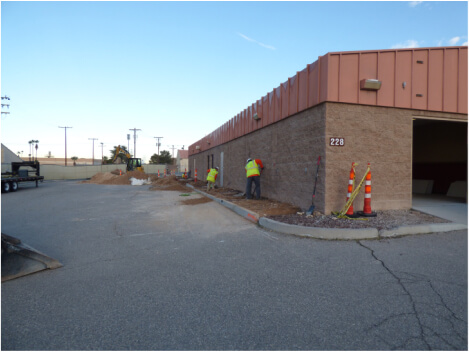
The damaged building sat directly adjacent to an active taxiway. F-16 Fighting Falcons — including Nellis-based aggressor aircraft and Weapons School instructor jets — were being prepped and taxied just feet from the potential construction zone throughout the day, creating three site conditions most foundation repair firms never face:
- Active jet-wash from F-16 engines capable of turning loose rocks, debris, or construction spoil into high-velocity projectiles
- Zero tolerance for FOD (foreign object debris) on or near the taxiway, where anything left on the ground could be ingested by an F-16 engine and destroy a multi-million-dollar aircraft
- A non-negotiable security and operational perimeter that constrained equipment size, staging area, and working hours
Any repair method that required large-scale excavation, heavy trucking, or significant spoil removal was both dangerous and potentially impossible to schedule without disrupting Air Force operations.
The Repair Methods That Wouldn’t Work
The engineering firm assigned to the project evaluated and eliminated several conventional approaches:
- Caissons were ruled out first. They required excavating and hauling away a substantial volume of soil, which meant extended site disruption and major FOD risk from spoil piles and truck traffic so close to the taxiway. Caissons also couldn’t lift the settled building back to level without additional mechanical equipment — a second step that added cost, time, and risk.
- Micro-piles were considered but had significant limitations for this specific application, including the loads, soil conditions, and lift requirements of the project.
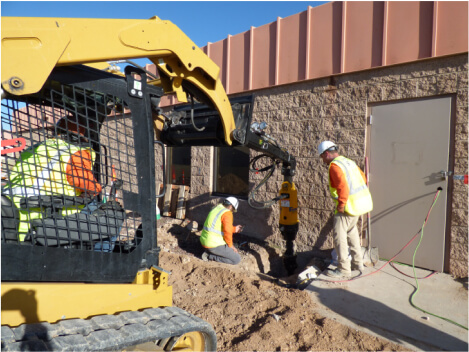
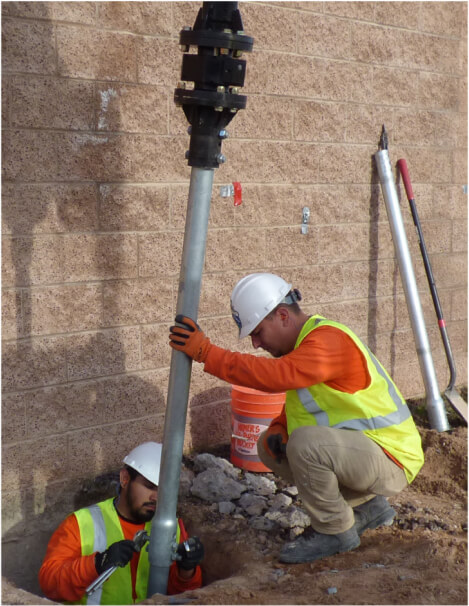
- Helical piles were ultimately specified as the best match for the conditions — installed with compact equipment, minimal excavation, minimal FOD exposure, and the ability to transfer load to competent soil strata while supporting controlled lift of the settled structure.
The Design Gap
Helical piles were the right call. But the engineering firm that specified them had limited hands-on experience with helical pile design and application. Time was short, and the solicitation was published before the specification had been fully developed by someone with the right technical background.
This is the kind of gap that quietly sinks foundation repair projects: the wrong pier, the wrong helix configuration, or the wrong depth gets specified because the engineer designing the job has never actually installed one. By the time the mistake surfaces, the contract has been awarded, materials have been ordered, and the client is looking at change orders, delays, or a repair that doesn’t hold.
Foundation Tech bid the project through three prime contractors and was awarded the contract. But before construction began, during the vetting and submittal process, we offered to assist with the engineering review.
Jerold Bronstrup of Foundation Tech provided all design criteria and load calculations for the project — specifying the correct helical pile, the correct helix configuration, the correct embedment depth, and the verified load requirements matched to Nellis’s specific soil conditions and the building’s structural loads. What began as a solicitation missing critical engineering inputs became a repair built on solid design calculations — before the first pile was ever driven.
That collaboration — offered proactively, before a single pile was driven — made the difference between a repair that would have likely struggled and one that delivered exactly what the Air Force needed.
The Outcome
Foundation Tech completed the installation ten days ahead of the project schedule, with a perfect production record — no safety incidents, no FOD events, no operational disruptions to the adjacent taxiway, and no delays to Air Force training.
Zero FOD Tolerance: Operational Discipline on an Active Airfield
The single greatest risk on this project was not structural — it was operational. A jet engine ingesting a single small stone or a piece of construction debris can destroy millions of dollars of aircraft in seconds, threaten the life of the pilot, and disrupt an entire training program. At Nellis, where the jet-wash from F-16s working immediately adjacent to the construction site could turn harmless-looking particles into projectiles, foreign object debris (FOD) was not a cleanup issue. It was a mission-critical risk.
Foundation Tech built FOD prevention into every phase of the work:
- Minimal spoils by design — the helical pile installation method was selected in part because it generates almost no excavated soil. Unlike caissons or conventional pier systems, helical piles are driven directly into the ground without hauling out volumes of dirt and rock. This dramatically reduced the amount of loose aggregate ever present on the site that could be picked up by wind or jet-wash.
- Daily tire tread inspections — every Foundation Tech truck entering the work area was inspected at the entrance control point, every day. Stones, gravel, and debris caught in tire treads are one of the most common sources of FOD incidents on military airfields, and the inspection protocol ensured that no vehicle ever brought foreign material into the operational zone.
- End-of-day vacuuming of all adjacent areas — at the close of each work shift, the construction zone and all surrounding areas adjacent to the taxiway were vacuumed to remove any fine particles, aggregate, or debris that could have migrated during the day’s operations. This went beyond standard construction site cleanup — it was airfield-grade decontamination.
These procedures were not optional. They were the cost of working next to an active Air Force taxiway, and Foundation Tech built them into the daily rhythm of the project from day one. The result: zero FOD incidents, zero aircraft engine exposures, and zero interruptions to Air Force operations throughout the entire installation.
Precision-Verified Load Capacity on Every Pile
Unlike conventional foundation support methods, helical piles can be load-verified as they are installed — the installation torque is a direct, real-time measurement of the soil’s ability to support the structure above. Every foot of pile driven into the ground produces a torque reading, and that reading correlates directly to the load capacity of the pile at that depth.
To ensure that every single pile met or exceeded its engineered minimum load capacity, Foundation Tech used a digital torque monitor on every pile installed. The monitor:
- Recorded torque values throughout the full installation depth of each pile
- Provided continuous, digital documentation of when each pile reached its specified minimum torque
- Generated a permanent installation record for every pile, available for submission to the engineer of record and the client
This is a critical difference between helical piles installed by firms with deep experience and those installed by contractors treating them as a novelty. Without real-time digital torque monitoring, a pile can be driven to its target depth without confirmation that it has actually reached adequate load-bearing capacity. With digital monitoring, every pile is a documented, verified structural support point — not a best guess.
100% Lift, Zero Additional Damage
With all helical piles installed, verified, and load-tested, Foundation Tech performed the structural lift of the compromised building, bringing the settled foundation back to its original design elevation.
Because every pile had been driven to its engineered load capacity and digitally verified, the lift itself was executed cleanly and without resistance — a sign that the design and installation had done their jobs correctly. The lift was performed in controlled, measured increments across all installed piles simultaneously, distributing the upward force evenly rather than concentrating stress on any single part of the structure. The result:
- 100% of the settled foundation was lifted back to level
- Zero additional cracking occurred in the already compromised CMU block walls during the lift
- Zero additional damage was introduced to the building’s interior finishes, mechanical systems, or structural elements
Site Restoration
After the lift was complete, Foundation Tech compacted and backfilled all pile excavation holes, returning the site to finish-grade condition. The prime contractor then took over the interior restoration work — repairing the CMU block wall cracks, patching the settled slab, and completing the finish work to return the classroom to full operational readiness.
For a building that had been declared uninhabitable and evacuated, returning it to full service without introducing any new damage during the repair is the highest possible outcome. And for the U.S. Air Force, that meant the Weapons School classroom was back in service — permanently — without a single training day lost that wasn’t already lost to the original water line failure.
What the Air Force Got
- A permanent structural repair, engineered and verified for Nellis’s specific soil conditions and loads
- Ten days returned to the project schedule
- A digital load-verification record for every pile installed
- A fully lifted and restored building, ready for immediate occupancy
- Zero FOD incidents and zero operational disruption to adjacent taxiway activities throughout the entire project
That’s what a correctly specified, correctly installed helical pile foundation repair looks like — executed by a contractor that understood both the technology and the site.
Contact Us
The Repair You Need Today Will Cost Less Than the Emergency You’ll Face Tomorrow.
Foundation Tech’s sales engineers are ready to evaluate your foundation or concrete issue, identify the most effective repair method, and deliver a comprehensive proposal with scope, timeline, and pricing.
Don’t wait for a small problem to become a shutdown.
[Talk to a Sales Engineer Today] · (661) 294-1313
Standard Business Hours
Monday – Friday 8:00 – 6:00 PST