Foundation Technology Construction provides expert HOA Associations and Concrete Infrastructure Repairs. Licensed, insured, and trusted by local customers.
About Our HOA Associations And Concrete Infrastructure Repairs Services
OPINION / INFRASTRUCTURE
Your HOA Board Is Gambling with Your Life Savings—and Maybe Your Life
The Concrete Beneath Your Building Is Failing. Your Board Doesn’t Understand Why. And Their Ignorance Is About to Cost You Everything.
Drawn from Cracking Under Pressure: The Hidden Crisis in America’s Parking Structures
Let’s start with a number that should keep every HOA board member in America awake tonight: $18,000.
That is the per-unit special assessment that residents of Ocean View Condominiums in Florida were hit with after their board delayed $400,000 in concrete repairs for three years to avoid raising HOA fees. By the time emergency structural work became unavoidable, the cost had tripled to $1.2 million. Twenty-three units went into foreclosure. The community spiraled into a financial crisis that took years to resolve.
And Ocean View got lucky. Nobody died.
At Champlain Towers South in Surfside, a condo board sat on a structural engineer’s report identifying “major structural damage” and a $15 million repair estimate for three years. The board deliberated. They sought second opinions. They treated a structural emergency like a routine capital decision. At 1:22 a.m. on June 24, 2021, the building collapsed. Ninety-eight people were killed. The total losses exceeded $1.2 billion—the largest construction disaster settlement in American history.
A preventive maintenance program implemented during the building’s early years would have cost $2 to $3 million.
A Pattern, Not an Accident
This is not a story about bad luck or freak engineering failures. It is a story about a pattern of willful ignorance, fiscal cowardice, and institutional incompetence that is replicated on HOA boards across the United States every single day. And the book Cracking Under Pressure, written by a structural concrete specialist with twenty years of field experience, lays out the evidence in terms that leave no room for the excuses boards have been hiding behind.
The Knowledge Gap That Kills
Here is the uncomfortable truth the book forces into the open: the people making life-and-death decisions about your building’s structural integrity are volunteers. These are not engineers. Not construction professionals. Not people trained in risk assessment. They are your neighbors—retirees, accountants, schoolteachers, small business owners—thrust into governance roles that require them to evaluate complex structural engineering reports, weigh multimillion-dollar repair estimates, and make decisions with direct consequences for human safety.
Most of them have no idea what they’re looking at.
The book describes a psychological disconnect that drives almost every failed HOA maintenance decision. Board members can see lobby furniture. They can touch new landscaping. They understand a fresh coat of paint. These are tangible, visible improvements that feel like responsible stewardship. A $200,000 concrete spalling repair, by contrast, is invisible. The work happens in a parking garage nobody wants to visit. The results are structural integrity that nobody can see. And the alternative—doing nothing—produces no immediate visible consequence.
So boards approve $15,000 for lobby furniture and reject $200,000 for structural repairs that would prevent $2 million in emergency reconstruction. They are not being malicious. They are being ignorant. And in the world of concrete chemistry, ignorance has the same outcome as malice.
The Exponential Curve Your Board Doesn’t See
The author puts it in terms every homeowner should understand: concrete deterioration does not follow a linear curve. It follows an exponential one. A $50,000 crack-injection and surface treatment in the early stages keeps a garage structurally sound for years. Delay that work, and corrosion begins. Corroding steel expands to seven times its original volume. Internal pressures exceed 2,000 psi against concrete that can withstand only 400 to 500 psi in tension. The concrete fractures from within. Cracks widen. Water penetrates deeper. Corrosion accelerates. What was a $50,000 maintenance item becomes a $500,000 structural repair. Then a $2 million reconstruction. Then a condemned building.
The dentistry analogy used in the book is exactly right: fill a cavity early and the tooth survives. Delay, and you’re looking at a root canal. Delay further, and you lose the tooth entirely. Except this tooth is your home. Your equity. Your family’s safety.
The Fiscal Catastrophe
If the safety argument does not reach your board, perhaps the financial one will. Because the economics of deferred maintenance in 2025 are no longer forgiving. They are punitive.
The era of cheap money that allowed boards to kick the can down the road is over. Commercial and construction financing now runs 8 to 11 percent. Emergency repair loans—the kind your board will need when the parking garage ceiling collapses—cost 10 to 15 percent. Borrowing $1 million for emergency concrete work now costs $80,000 to $150,000 per year in interest alone. That is money that could have funded decades of preventive maintenance.
But the lending environment is only the beginning. Banks now require comprehensive structural assessments for any building over twenty-five years old before approving financing. They require proof of ongoing preventive maintenance programs. They require reserve funds of six to twelve months of maintenance costs held in escrow. HOA communities that have neglected their structures are discovering they are locked out of financing entirely.
The insurance market has become even more brutal. Following Surfside, carriers across the industry restructured their approach to concrete structural risk. Most policies now exclude coverage for “gradual deterioration” and “maintenance-related failures.” Structural assessments you need for renewal on buildings over thirty years old. Premium increases of 50 to 300 percent are routine for buildings without maintenance documentation. In many cases, coverage has become unavailable at any price.
Read that again: unavailable at any price.
When the Insurer Agrees—and Still Denies Your Claim
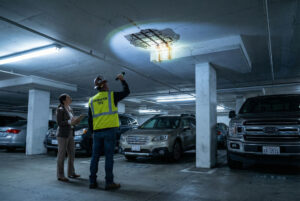
The book recounts a case from the author’s own practice that should terrify every HOA board in the country. His company was hired to investigate a parking garage failure in a Los Angeles-area condominium where a large section of delaminated concrete fell through the windshield of a homeowner’s car overnight. Repair estimates exceeded $1 million. An insurance claim was filed. The insurance company brought in its own engineers, agreed with the diagnosis and repair methods, and then denied the claim—ruling it the result of neglect and lack of maintenance. Litigation dragged on for years. The HOA lost. Meanwhile, the Los Angeles Building Department yellow-tagged the building. Half the homeowners were forced to move out. Property values collapsed. Mortgage lenders refused to finance unit sales. Owners who wanted to abandon the project couldn’t find buyers.
That is what fiscal “responsibility” looks like when your board’s definition of saving money is ignoring a structural engineer’s recommendations.
The Special Assessment Death Spiral
The cruelest irony of deferred maintenance is that the boards who delay repairs to “protect” homeowners from financial burden end up inflicting financial devastation orders of magnitude worse than the original repair would have cost.
When emergency repairs become unavoidable, unit owners face special assessments of $10,000 to $30,000 or more. For retirees on fixed incomes—exactly the demographic most likely to resist spending—these assessments are catastrophic. Some cannot pay. Delinquencies mount. Foreclosures follow. Each foreclosure reduces the association’s revenue base, increasing the burden on remaining owners. Property values decline 10 to 30 percent as structural problems become public knowledge. Prospective buyers disappear. Lenders refuse to finance purchases. The community enters a financial death spiral from which recovery takes years—if it comes at all.
Every dollar your board “saves” by deferring concrete maintenance is a dollar that compounds against your community at rates that would make a loan shark blush. The book documents a consistent cost multiplier across geographies and building types: deferred maintenance costs ten to thirty times more than prevention. That is not an opinion. It is the mathematics of concrete chemistry.
The Legal Exposure Your Board Doesn’t Know About
There is one more dimension to this crisis that most HOA boards have not considered, because most HOA boards have never been told: criminal liability.
Courts across the country are increasingly treating concrete deterioration as a public safety issue. Civil liability for deferred maintenance is well established—property values decline, personal injury lawsuits follow falling concrete, and insurance companies deny claims rooted in neglect. But the legal landscape has evolved beyond civil penalties.
Under statutes like California Penal Code Section 192(b), property owners—and that includes HOA board members making governance decisions about structural maintenance—who receive professional engineering reports identifying serious structural hazards and choose to defer repairs can face involuntary manslaughter charges if someone dies. Criminal negligence in concrete cases typically involves receipt of professional warnings, understanding that deterioration poses safety threats, and choosing to defer necessary repairs for financial reasons despite knowing the risks.
The penalties are not theoretical. Involuntary manslaughter is a felony carrying two to four years in state prison, fines up to $10,000, and a permanent criminal record. A criminal conviction also establishes negligence for civil lawsuits, which routinely produce multimillion-dollar damage awards.
After the Ann Street parking garage collapse in New York City in 2023 that killed a 59-year-old garage manager, the city’s Buildings Commissioner declared the tragedy “entirely preventable”—the result of human errors, not engineering failures. The building had documented concrete violations dating to 1957. Decades of maintenance failures. Cracked concrete, corroded steel, exposed reinforcement. All documented. All ignored.
The Paper Trail That Leads to a Felony
If your board has received a structural engineering report recommending concrete repairs and has voted to defer that work, every board member who cast that vote has created a paper trail that a prosecutor can follow directly to a criminal charge if someone is injured or killed.
That is not an alarmist interpretation. That is the current state of the law.
The Question Every Board Must Answer
The author poses a question in the book that deserves to be printed and placed on the table at every HOA board meeting in America: Will we control this process, or will it control us?
The concrete beneath your building is not a static object. It is a chemical system undergoing continuous change. It is either improving through active maintenance or deteriorating through environmental exposure. There is no steady state. No pause button. Every month your board defers assessment and repair, the costs increase, the risks compound, and the options narrow.
The solutions exist. Cathodic protection halts corrosion even after it has started. Protective coatings prevent water infiltration. Chloride extraction removes accumulated salt contamination. Structural monitoring systems provide real-time data on deterioration. None of these are experimental technologies. All are proven. All are available. And all are dramatically less expensive than the emergency reconstruction your board is sleepwalking toward.
But they only work if your board acts before the deterioration curve goes exponential. The intervention window is typically between fifteen and twenty-five years after construction. After that, you are not maintaining a structure. You are rebuilding one.
Three Questions to Ask Tonight
So here is what you should do tonight. Ask your board three questions:
First: When was the last time a licensed structural engineer—not a general inspector, not a property manager, but a qualified structural engineer experienced in concrete deterioration—performed a comprehensive assessment of your building’s concrete? Not a visual walk-through. A real evaluation including chloride testing, corrosion mapping, and delamination surveys.
Second: If an engineering report exists, what did it recommend, and what has the board done about those recommendations? Is there a paper trail showing the board received professional warnings and chose to defer?
Third: What is the current balance of your association’s reserve fund for structural maintenance, and does it reflect the actual projected cost of concrete repairs over the next ten to twenty years based on professional engineering estimates?
The Clock Is Already Running
If your board cannot answer these questions clearly and completely, your community is operating blind. You are trusting volunteers with no structural engineering expertise to make decisions about the chemical and mechanical processes that determine whether your building stands or falls.
The Champlain Towers South condo board had an engineering report sitting on their desk for three years. The information was in their hands. The professional recommendation was on record. Fifteen million dollars in identified repairs could have been phased, financed, and managed. Instead, the board chose to deliberate while the concrete chemistry that would kill 98 of their neighbors continued its relentless, indifferent progression.
Your board is making the same choice right now. The only variable is the timeline.
The concrete does not care about your budget. It does not care about your board’s comfort level. It does not care about the next election cycle or the special assessment that will make homeowners angry. The chemistry proceeds at its own pace, on its own schedule, toward its own conclusion.
The only question is whether your board will act while the math still works in your favor—or wait until it doesn’t.
Cracking Under Pressure: The Hidden Crisis in America’s Parking Structures is available now.
Foundation Technology Construction — Home
For industry standards and best practices, visit the Better Business Bureau.